


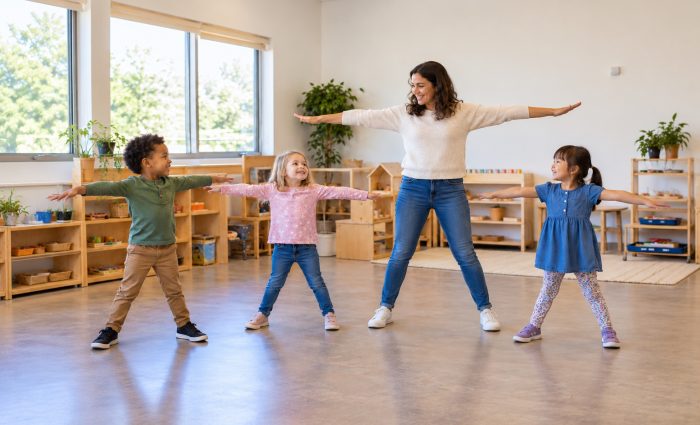

10-Minute Preschool Movement Routines: Building Postural Control, Coordination, and Body Awareness
Simple, purposeful movement activities for children ages 3–4 that teachers can use to practice foundational motor skills in just ten minutes.
By Irene Hannam, MS, OTR/L | Write Expectations™
Introduction: Ten Minutes of Meaningful Movement
Preschoolers learn by moving!
They crawl, climb, push, pull, reach, carry, squeeze, and explore throughout their day. These everyday movements give children opportunities to develop foundational motor skills such as postural control, bilateral coordination, balance, body awareness, and motor planning.
These skills are important for classroom activities. A child uses postural control to sit comfortably during circle time, both hands to manage paper and scissors, and body awareness to move safely around furniture and classmates.
Teachers can help children practice these movements through short, playful classroom activities.
And the best part? You don’t need specialized equipment or a complicated lesson plan.
This guide provides a ready-to-use 10-minute preschool movement routine, including:
- A simple schedule teachers can follow immediately
- Easy movement activities with specific directions and teacher cues
- Examples of how to use activities with three- and four-year-olds
- Proprioceptive activities using ordinary classroom materials
- Ideas for changing activities throughout the week
- Practical suggestions for supporting different developmental needs
- Safety precautions and a quick observation tool
The purpose is to provide enjoyable opportunities for children to practice foundational movement patterns and participate in preschool routines.
This is a flexible classroom activity program, not a standardized therapeutic protocol. Children should participate in ways appropriate for their developmental abilities, comfort, and individual needs.
1. Your Ready-to-Use 10-Minute Preschool Movement Routine
Start here! This is the routine teachers can use without reading the entire article first.
Before You Begin
Group: Begin with a manageable group (often about 6–10 children when space and staffing permit). Use smaller groups when children need more supervision or individualized support.
Space: A clear classroom area with room for children to stretch their arms without touching one another.
Materials:
- A stable wall
- Optional picture cues or a simple visual activity schedule
- Optional non-slip floor mats
- Optional familiar classroom objects
No specialized equipment is required. Movement alternatives and supervision take priority over completing the exact sequence.
Preparation: Allow a few minutes to check the space, review individual needs, and demonstrate the movements. Setup becomes faster once the routine is familiar.
Explain that children will follow a short movement adventure together. Model each movement and use the same simple cues each time.
Before Starting: Review students’ individualized health and safety plans, movement restrictions, and supervision needs. Offer seated, standing, or supported options when appropriate. Stop if a child experiences pain, dizziness, unusual fatigue, distress, or difficulty maintaining a safe position. See Section 7 for additional precautions.
The 10-Minute Plan
Time | Activity | What Children Do | Motor Focus |
0–1 min | Hello, Movers! | Listen to the teacher’s introduction, watch the demonstration, and find a comfortable starting spot. Use picture cues when helpful. | Predictability and movement planning |
1–3 min | Starfish & Popcorn | Stand with feet hip-width apart; keep feet planted while opening arms and hugging. Then curl and grow tall for Popcorn. | Body awareness, bilateral movement, changing positions |
3–5 min | Puppy Rocking | Move onto hands and knees and gently rock forward and back | Postural control, shoulder support, weight shifting |
5–7 min | Cross-Body Treasure | Reach across the body to touch the opposite knee or retrieve an optional classroom object | Crossing midline, reaching, coordination |
7–9 min | Push the Castle Wall | Place hands against a wall and gently push, then relax | Upper-body support, controlled force, proprioceptive input |
9–10 min | Quiet Starfish Finish | Return to a comfortable position, give a gentle hug if desired, and transition | Predictable ending and classroom participation |
Total: 10 minutes, including activity changes and transitions.
Teachers do not need to fill every second. The suggested times are flexible, and fewer activities may be appropriate for some groups.
How to Actually Run It with Your Class
For a group of eight preschoolers, begin by clearing an area where children have enough room to move safely. You do not need specialized equipment. Demonstrate each activity before asking children to participate.
Starfish & Popcorn: Have children stand in their own spaces with feet about hip-width apart. For Starfish Hug, keep both feet planted as the arms open and cross for a gentle hug. Then demonstrate making the body small and growing tall for Popcorn. Offer supported sitting when needed.
Puppy Rocking: Invite children who can comfortably participate to move onto their hands and knees. Demonstrate three to five gentle forward-and-back rocking movements. Offer a supported standing or seated alternative when appropriate.
Cross-Body Treasure: Have children sit comfortably. Say, “Let’s find our treasure!” Demonstrate reaching your right hand across your body to touch your left knee. Then reach your left hand across to touch your right knee. Repeat slowly three to five times, alternating sides as comfortable.
For a fun variation, place two or three large classroom objects or pictures to either side of a small group and let children take turns reaching across their bodies to collect the “treasure.”
Push the Castle Wall: Invite children to stand at a stable wall with enough space between them. Demonstrate three gentle pushes. If wall space is limited, divide the group or provide an appropriate seated alternative.
Quiet Starfish Finish: Return to a comfortable position. If standing, keep feet about hip-width apart and planted while opening the arms and giving a gentle hug, if desired. Take a comfortable breath before transitioning to the next classroom activity.
Teacher Tip: No special materials are required. Children can practice these foundational movement patterns by using their own bodies. Simple classroom objects, pictures, or familiar toys can make activities more playful when available.
Download the Two-Page Preschool Movement Guide
2. The Five Core Activities: Exactly What to Say and Do
Activity 1: Starfish Hug
Motor Focus: Bilateral arm coordination and body awareness.
Teacher Directions
- Have children stand with feet about hip-width apart, both feet flat on the floor, and knees relaxed.
- Open both arms out to the sides at about shoulder height, or as far as comfortable, to make a starfish.
- Slowly cross both arms over the chest for a gentle self-hug. Keep the feet apart and planted; only the arms move.
- Open the arms again while keeping the same comfortable standing position.
- Repeat approximately 3–5 times as comfortable.
Say: “Feet stay still. BIG starfish! Now give yourself a gentle hug. Open…and hug!”
For three-year-olds: Model one step at a time. Use BIG and HUG while reminding children to keep their feet still.
For four-year-olds: Encourage smoother opening and closing movements. Children may alternate which arm crosses on top, if comfortable.
What to Look For: Does the child move both arms together while maintaining comfortable standing balance? Can the child follow the simple pattern?
Classroom Connection: Using both arms together, body awareness, and movement during play.
Simple Modification: Complete the same arm movements while seated with back and feet supported as needed. A child may hug a stuffed animal instead.
Activity 2: Popcorn
Motor Focus: Controlled body movement, balance, and changing positions.
Teacher Directions
- Ask children to pretend they are popcorn kernels.
- Bend the knees or curl the body into a comfortable small position.
- Say, “The popcorn is getting warm!”
- Count, “Three, two, one…POP!”
- Slowly stand tall and open the arms.
- Repeat approximately 3 times as comfortable.
Say: “Make your body SMALL…now grow BIG!”
For three-year-olds: Keep it simple—small body, big body.
For four-year-olds: Encourage smooth changes in position rather than moving quickly.
What to Look For: Can the child change positions while maintaining balance and control?
Classroom Connection: Moving between positions during play and classroom routines.
Simple Modification: Perform small-and-big arm movements in supported sitting.
Safety: Jumping is not required. Do not encourage children to throw their heads backward, jump forcefully, or squat deeper than is comfortable.
Activity 3: Puppy Rocking
Motor Focus: Postural control, shoulder stability, and controlled weight shifting.
Teacher Directions
- Demonstrate getting onto hands and knees.
- Invite children to position their hands comfortably beneath the shoulders and knees beneath the hips.
- Say, “We’re little puppies!”
- Gently rock the body forward a small distance.
- Rock backward toward the starting position.
- Repeat approximately 3–5 times.
Say: “Puppy rocks forward…and back. Forward…and back.”
For three-year-olds: Begin by holding the hands-and-knees position briefly. Add small rocking movements when ready.
For four-year-olds: Encourage controlled weight shifting while keeping the arms stable.
What to Look For: Can the child comfortably support the body on hands and knees? Does the child control the movement without losing balance?
Classroom Connection: Upper-body support, movement planning, and changes in body position.
Simple Modification: Have the child stand with hands against a stable wall and practice small, gentle weight shifts.
Safety: Keep the movement comfortable. Do not force joint positions or push the child’s body through the activity.
Activity 4: Cross-Body Treasure
Motor Focus: Crossing midline, coordinated reaching, and body awareness.
Materials: None required. Familiar classroom objects are optional.
Teacher Directions
- Ask children to sit or stand comfortably.
- Say, “Let’s find our treasure!”
- Demonstrate reaching your right hand across your body to touch your left knee.
- Return your hand to a comfortable position.
- Reach your left hand across your body to touch your right knee.
- Repeat approximately 3–5 times, alternating sides as comfortable.
Say: “Reach across to find your treasure! Right hand to left knee. Left hand to right knee!”
For three-year-olds: Demonstrate one reach at a time using simple, familiar directions.
For four-year-olds: Encourage controlled alternating movements. Add a simple two-step sequence when appropriate.
Optional Variation: Use two or three sufficiently large, age-appropriate classroom objects. Children take turns reaching across their bodies to retrieve an object and place it in a basket.
What to Look For: Can the child reach across the body comfortably while maintaining an appropriate position?
Classroom Connection: Coordinated reaching, body awareness, and retrieving classroom materials.
Simple Modification: Reduce the reaching distance or provide a supported seated position. Children may reach toward a closer body target when touching the opposite knee is uncomfortable.
Safety: Do not force a particular hand, restrict comfortable trunk movement, or require an uncomfortable reaching pattern. Any optional objects must be age-appropriate and free of choking hazards.
Activity 5: Push the Castle Wall
Motor Focus: Upper-body weight bearing, shoulder stability, and controlling force.
Teacher Directions
- Have children face a stable wall.
- Place both hands on the wall at a comfortable height.
- Keep the feet in a stable position.
- Gently push against the wall for approximately 3 seconds.
- Repeat approximately 3 times.
Say: “Push the castle wall…push…push…STOP!”
For three-year-olds: Use simple picture handprints or visual demonstration.
For four-year-olds: Add the challenge of pushing and stopping in response to a familiar cue.
What to Look For: Can the child maintain balance and apply a controlled amount of force?
Classroom Connection: Body awareness, upper-extremity support, and controlling pressure during everyday tasks.
Simple Modification: Move closer to the wall to reduce effort or use an appropriate seated pushing alternative.
Safety: Use a stable wall, avoid forceful pushing, and allow children to stop if uncomfortable.
3. What Is Proprioception, and Why Include Pushing and Carrying?
Proprioception is information from our muscles and joints about body position, movement, and force.
Think about a child gently pushing against a stable wall, carrying a lightweight classroom object, squeezing play dough, or climbing approved playground equipment. Each activity provides opportunities to coordinate movement and adjust the amount of force being used.
These everyday activities provide proprioceptive input and opportunities to practice controlled movement.
In occupational therapy and education, people sometimes call pushing, pulling, carrying, and squeezing activities heavy work.
For preschoolers, however, heavy work should not mean heavy lifting or strenuous exercise.
Easy Classroom Examples
Movement | Try This | How to Use It |
Push | Wall Push | Before a classroom transition, practice three gentle pushes together |
Pull | Pull apart large construction toys | During centers, invite children to pull the pieces apart and reconnect them |
Carry | Classroom Delivery | Carry one or two lightweight items to a nearby basket |
Crawl | Puppy Trail | Crawl along a short, clear pathway during a movement game |
Squeeze | Play-Dough Bakery | Squeeze, roll, and pinch dough during a fine-motor center |
Climb | Approved playground equipment | Practice climbing during supervised outdoor play |
Step | Floor-Spot Path | Step between several non-slip floor markers while following a simple route |
Classroom Example:
Before a fine-motor center, the teacher says: “First, let’s push the castle wall three times. Now we’re going to our tables to make play-dough cookies.”
Children complete the brief movement and transition to their planned classroom activity.
The wall pushes offer movement practice. The play-dough center then provides direct opportunities to squeeze, roll, pinch, and manipulate materials.
Teachers can observe whether the children participate comfortably in both activities.
Important: Proprioceptive activities are not automatically calming for every child. Some children become more alert after movement; others prefer a quieter transition. Observe the individual response rather than assuming a particular activity will improve attention or regulation.
4. Easy Activity Swaps: Keep the Routine, Change the Adventure
One of the easiest ways to maintain children’s interest is to keep the same routine structure while changing an activity or theme.
You do not need an entirely new set of exercises every day.
Use the five core activities first. Once children know the routine, substitute one or two of the following.
Bear Hunt
- Works on: Crawling, coordination, body awareness, and changing gaze.
- How: Place two large animal pictures along the sides of a short, clear floor pathway. Invite children to crawl comfortably and look for each animal.
- Say: “We’re going on a bear hunt! Can you find the yellow bear?”
- Adaptation: Children may walk or move along an accessible pathway instead of crawling.
Floor Angels
- Works on: Bilateral coordination and body awareness.
- How: Have children lie comfortably on their backs and move both arms outward and inward. Add gentle leg movements if appropriate.
- Say: “Make a BIG snow angel…now bring your arms back.”
- Adaptation: Complete the arm movements while seated.
Play-Dough Bakery
- Works on: Hand manipulation, finger coordination, and bilateral hand use.
- How: Give children suitable play dough and ask them to squeeze a lemon, roll a snake, pinch cookies, and press the dough flat.
- Say: “Five big squeezes! Now roll a long snake!”
- Adaptation: Use a suitable alternative material when needed. Check allergies and supervise children who may put materials in their mouths.
Carry the Treasure
- Works on: Body awareness, bilateral coordination, controlled carrying, and motor planning.
- How: Children carry one large, lightweight object along a short, clear route and place it in a basket.
- Say: “Let’s deliver our treasure to the castle!”
- Adaptation: Provide accessible object placement and a seated delivery option.
- Safety: If several children are participating, use separate clear pathways or take turns to prevent collisions. Objects must be light enough to carry comfortably.
Puppy Finds the Butterfly
- Works on: Head control and maintaining body position.
- How: From a comfortable hands-and-knees position, invite children to look between two pictures placed at slightly different distances.
- Say: “Find the butterfly! Now find the ladybug!”
- Adaptation: Use a seated or standing version with pictures at comfortable viewing heights.
- Safety: Avoid exaggerated neck movements or forcing a head position.
5. Three Sample Classroom Routines for the Week
Teachers may use the same routine repeatedly or rotate among these examples. Consistency helps children learn the sequence, while occasional changes provide different movement experiences.
These examples are flexible classroom schedules, not prescribed treatment frequencies or dosages.
Time | Monday: Ocean Adventure | Wednesday: Puppy Adventure | Friday: Castle Adventure |
1 minute | Welcome and demonstrate movements; use picture cues if helpful | Welcome and demonstrate movements; use picture cues if helpful | Welcome and demonstrate movements; use picture cues if helpful |
2 minutes | Starfish Hug and Popcorn | Starfish Hug | Popcorn |
2 minutes | Floor Angels | Puppy Rocking | Bear Hunt |
2 minutes | Cross-Body Treasure | Cross-Body Treasure | Cross-Body Treasure |
2 minutes | Wall Push | Wall Push | Wall Push or Carry the Treasure |
1 minute | Quiet finish | Quiet finish | Quiet finish |
Example: How to Use the Friday Castle Adventure
Tell the class: “Today we’re going to visit a castle!”
Start by making your bodies small like popcorn kernels and growing tall.
Next, invite the children to travel along a short bear trail. In a group with limited floor space, have children move in small, supervised groups or use standing animal movements.
Then, invite children to find their pretend treasure by reaching across to touch the opposite knee. If you have suitable classroom objects available, children may take turns reaching across their bodies to collect them.
Finish with gentle pushes against the castle wall.
Announce, “Our castle adventure is finished!” Use a DONE picture if helpful, then guide children into their next classroom routine.
A predictable sequence with small changes is usually easier to manage than a completely new obstacle course every day.
6. What If a Movement Activity Isn’t Working?
Preschool activities rarely go exactly as planned, especially when children have different motor abilities, attention needs, and communication styles.
Here are some common situations.
What You Notice | What the Teacher Can Try |
Children are losing interest | Shorten the activity, use a familiar character, or switch to the next movement |
A child cannot maintain hands and knees | Use supported wall movements or another accessible activity |
A child becomes excited by Popcorn | Eliminate the countdown and use slow Starfish Hug movements |
Children bump into one another | Increase spacing, reduce group size, or use stationary activities |
A child has trouble following directions | Demonstrate one movement at a time and use picture cues |
A child cannot reach across the body comfortably | Move the object closer and allow a functional reaching pattern |
A child appears tired or uncomfortable | Stop the activity, offer rest, and review whether the activity is appropriate |
The class has only five minutes | Use Starfish Hug, Cross-Body Treasure, and Wall Push with a predictable finish |
There is not enough wall space for every child | Divide children into smaller supervised groups or invite them to gently press their palms together for approximately three seconds. Palm pressing provides an alternative force-control activity rather than the same weight-bearing experience as wall pushes. |
Example: Two Children, Different Abilities
A teacher invites the class to complete Puppy Rocking.
One child comfortably maintains a hands-and-knees position and performs several slow rocks.
Another child has difficulty supporting body weight through the hands.
Rather than requiring both children to complete the movement identically, the teacher offers the second child a stable wall and demonstrates gentle weight shifting while standing.
Both children have opportunities to practice a related movement component in an accessible way.
Success means meaningful participation, not identical performance.
For more detailed adaptations involving mobility, postural stability, sensory processing, motor planning, and communication, see our companion article: Supporting Motor Development in Preschool: Movement Activities and Classroom Adaptations
7. Important Medical and Safety Considerations
Before introducing movement activities, teachers should consider each child’s known medical conditions, physical restrictions, and individualized health or safety plans.
Children with seizure disorders, cardiac or respiratory conditions, orthopedic restrictions, significant mobility limitations, or other medical considerations may require modifications or additional precautions.
Always follow existing Individualized Healthcare Plans, Seizure Action Plans, emergency procedures, and school safety protocols.
When the safety or appropriateness of a movement is uncertain, consult the school nurse or an appropriate healthcare professional before participation.
A medical diagnosis does not automatically prevent a child from participating. The goal is safe, inclusive movement that respects individual needs and established recommendations.
Quick Safety Check
Before the routine:
- Clear the movement area and check for slipping or tripping hazards.
- Provide sufficient space between children.
- Use only stable, age-appropriate equipment and materials.
- Avoid small objects that may be choking hazards.
- Avoid heavy or unstable containers, forced movements, and excessive joint loading.
- Provide appropriate supervision and accessible alternatives.
- Allow children to request a break, choose another activity, or decline participation.
- Stop if a child experiences pain, dizziness, unusual fatigue, distress, or difficulty maintaining a safe position.
Movement should be playful, comfortable, and adjusted to each child’s needs. Do not require children to complete every activity to participate successfully.
8. What Should Teachers Observe?
Teachers only need to identify one useful skill and notice how the child participates.
For example:
Functional Motor Area | Example of What to Observe |
Postural control | Can the child maintain a comfortable position during Puppy Rocking? |
Bilateral coordination | Does the child use both arms together during Starfish Hug? |
Crossing midline | Can the child reach toward an object on the opposite side? |
Motor planning | Can the child follow a familiar two-step movement sequence? |
Force control | Can the child push gently and stop on cue? |
Classroom participation | Can the child transition from the routine to the next activity with appropriate support? |
Simple Progress Example:
Target: Following a familiar three-step movement sequence.
Initial Observation: The child completes the first step with modeling but needs additional directions for the remaining steps.
Strategy: Demonstrate the same familiar three-step movement sequence using simple, consistent teacher cues. Add picture cards or gestures for children who benefit from visual support.
Later Observation: The child completes the first two steps independently and begins the final step after one gesture.
This suggests improved participation in the familiar routine.
However, completing an exercise does not automatically demonstrate improvements in handwriting, attention, sensory regulation, or another unrelated classroom skill. Those outcomes must be observed directly.
Teacher Tip:
If a child has difficulty with an important classroom task, observe that task too.
For example, if you are supporting bilateral coordination, notice whether the child uses the assisting hand to stabilize paper during coloring or manages objects with both hands during play.
The meaningful question is not simply, “Can the child do the movement?”
It is also, “How is the child participating in everyday preschool activities?”
9. What Does Research Tell Us?
Research supports providing purposeful movement opportunities as part of a child’s preschool experience.
Structured Motor Practice: Chen et al. (2024) conducted a meta-analysis of 23 studies involving 4,068 preschool children. Structured and unstructured interventions were associated with improvements in fundamental motor skills, with structured activities showing particular advantages for locomotor skills. The findings support repeated, purposeful movement opportunities but do not validate the specific ten-minute routine in this article.
Daily Physical Activity: The Centers for Disease Control and Prevention (2025) recommends that children ages 3–5 remain physically active throughout the day through varied, enjoyable movement experiences. A ten-minute routine should complement outdoor play, playground activities, and active classroom experiences—not replace them.
Sensory-Based Activities: Piller et al. (2025) reviewed 21 studies of sensory-based interventions for children and youth. The strength of evidence varied depending on the intervention and outcome. The findings do not establish that pushing, crawling, or other proprioceptive activities automatically calm every child or improve attention.
Inclusive Early Childhood Practices: The Division for Early Childhood (2014) emphasizes participation in natural learning environments, individualized support, and embedding practice into everyday routines.
Universal Design for Learning: CAST (2024) encourages multiple ways to access activities, participate, communicate, and demonstrate learning. These principles support adapting classroom movement activities rather than requiring every child to complete the same movement.
Research Takeaway: A short, predictable classroom routine can provide useful motor practice. Activities should be developmentally appropriate, accessible, safe, and connected to meaningful participation. This particular routine has not been independently validated as a therapeutic intervention or proven to produce specific academic or behavioral outcomes.
Conclusion: Small Movements, Meaningful Opportunities
Preschoolers develop motor skills through movement, exploration, and play.
Short activities such as Starfish Hug, Popcorn, Puppy Rocking, Cross-Body Treasure, and Wall Push provide practical opportunities to practice postural control, bilateral coordination, body awareness, and motor planning.
A consistent 10-minute classroom routine makes it easier for teachers to provide these movement experiences without complicated preparation or specialized equipment.
Keep the activities playful. Keep the directions simple. Adjust for the child.
The goal is not to complete every activity perfectly. It is to provide safe, meaningful opportunities for children to move, practice, and participate.
At Write Expectations™, we believe strong foundations grow through purposeful movement, appropriate support, and everyday opportunities for children to succeed.
References
CAST. (2024). CAST Universal Design for Learning Guidelines version 3.0. https://udlguidelines.cast.org/
Centers for Disease Control and Prevention. (2025, December 4). Child activity: An overview. https://www.cdc.gov/physical-activity-basics/guidelines/children.html
Chen, D., Zhao, G., Fu, J., Shun, S., Su, L., He, Z., Chen, R., Jiang, T., Hu, X., Li, Y., & Shen, F. (2024). Effects of structured and unstructured interventions on fundamental motor skills in preschool children: A meta-analysis. Frontiers in Public Health, 12, Article 1345566. https://doi.org/10.3389/fpubh.2024.1345566
Division for Early Childhood. (2014). DEC recommended practices in early intervention/early childhood special education 2014. https://www.dec-sped.org/dec-recommended-practices
Piller, A., McHugh Conlin, J., Glennon, T. J., Andelin, L., Auld-Wright, K., Teng, K., & Tarver, T. (2025). Systematic review of sensory-based interventions for children and youth (2015–2024). Frontiers in Pediatrics, 13, Article 1720179. https://doi.org/10.3389/fped.2025.1720179
Educational and Safety Disclaimer
The information and movement activities provided by Write Expectations™ are intended for general educational purposes and professional reference. They are not intended to diagnose, treat, or prevent any medical or developmental condition and do not replace individualized occupational therapy evaluation, medical advice, or professional intervention.
Activities should be selected and modified according to each child’s developmental abilities, physical needs, comfort, and functional goals. Appropriate adult supervision is required. Activities should be discontinued if a child experiences pain, dizziness, unusual fatigue, distress, or difficulty maintaining a safe position.
Children with seizure disorders, cardiac or respiratory conditions, orthopedic restrictions, physical disabilities, or other medical considerations may require individualized movement precautions. Teachers and caregivers should follow established medical recommendations, Individualized Healthcare Plans, Seizure Action Plans, school health procedures, and emergency response protocols. When the safety or appropriateness of an activity is uncertain, consult the school nurse or an appropriate healthcare professional before participation.
Educators, caregivers, and other professionals are responsible for determining whether an activity is appropriate for the children in their care and for following applicable safety procedures and individualized support plans.
Participation in these activities does not guarantee specific developmental, therapeutic, behavioral, sensory, or academic outcomes.
Write Expectations™ | Occupational Therapy Resources for School Success
© 2026 Write Expectations™. All rights reserved.
1 Comment
Primitive Reflexes in Preschool Classrooms - writeexpectations
October 26, 2026[…] For a structured classroom movement program, explore our companion article, 10-Minute Preschool Movement Routines: Building Postural Control, Coordination, and Body Awareness. […]