



Executive Function and Handwriting: The Hidden Connection
By Irene Hannam, MS OTR/L
A student knows how to form every letter. When asked to write the alphabet, she performs well. When copying a short sentence in a quiet setting, her handwriting is readable.
Then she is asked to answer a question during science.
Her spacing becomes inconsistent. Letters begin to drift off the line. She leaves out words, forgets punctuation, loses her place, or fails to finish. As the task becomes more effortful, she may pause frequently, press more heavily on the pencil, or become frustrated.
It may appear that her handwriting skills have disappeared. More often, the demands surrounding handwriting have changed.
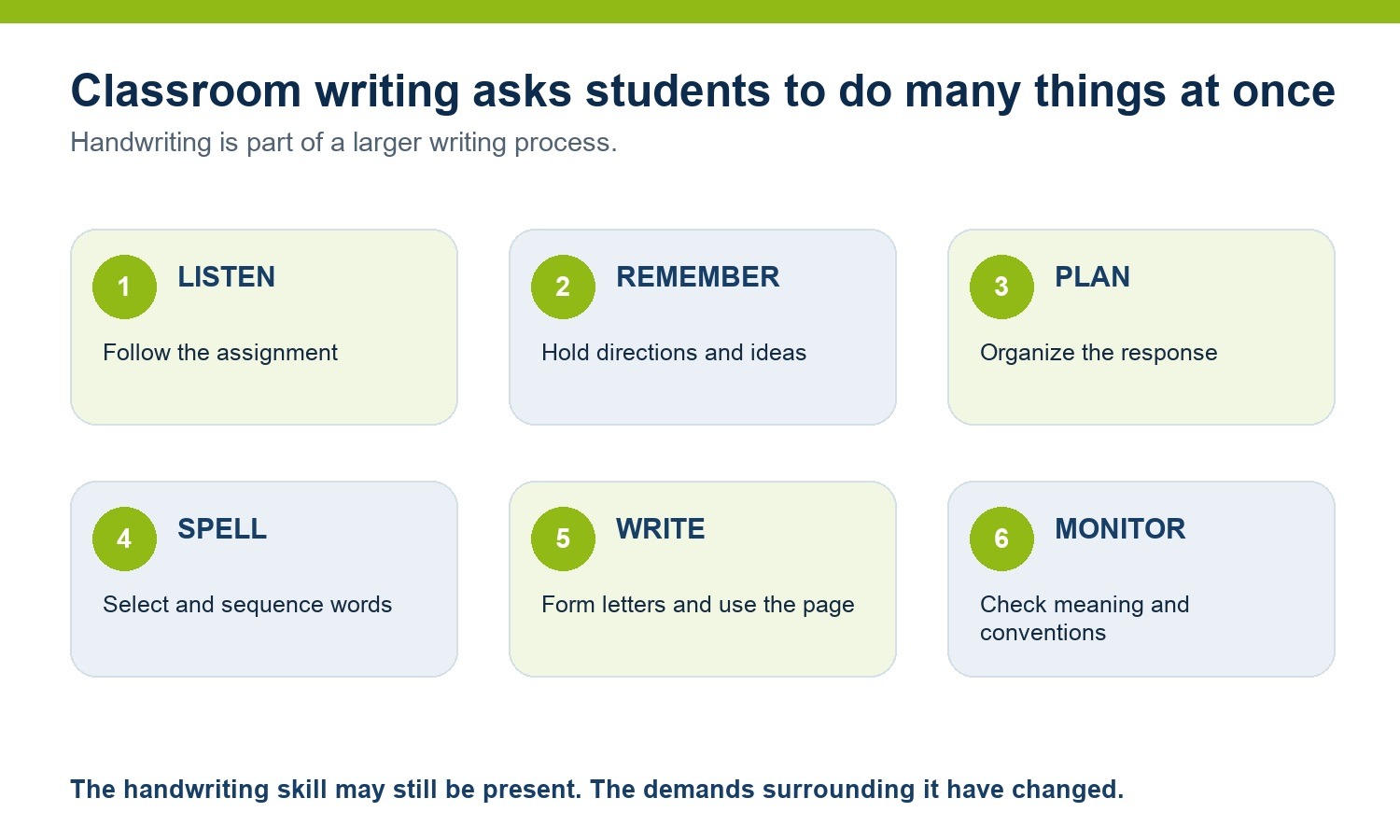
Handwriting does not occur in isolation during the school day. Students may need to write while listening, remembering directions, organizing ideas, spelling words, monitoring the page, managing time, and ignoring distractions. These processes draw on attention, language, transcription skills, executive functioning, and physical endurance.
This hidden connection helps explain why a student’s handwriting and written output may look very different across tasks, settings, and times of day.
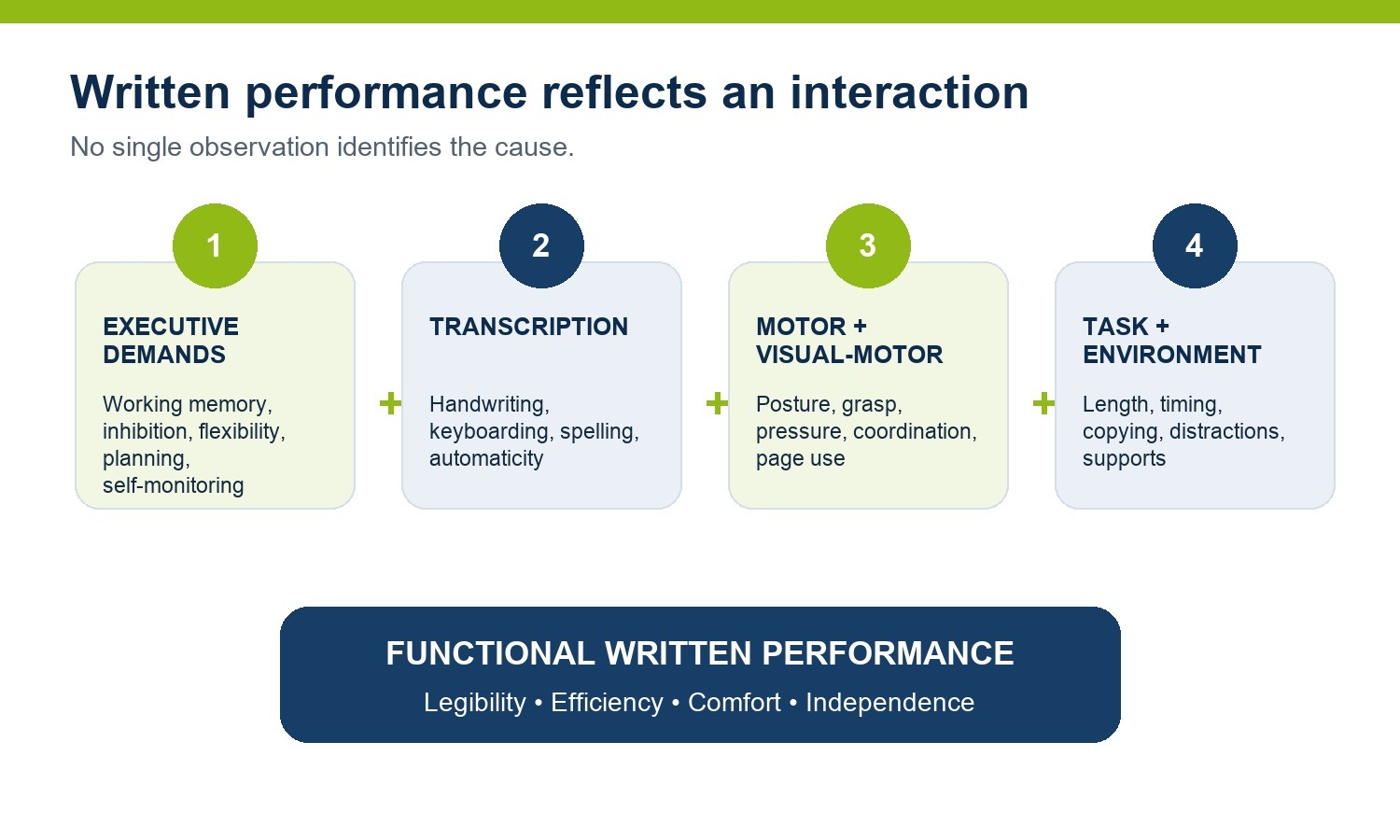
From an occupational therapy perspective, the concern is not simply whether a student can form letters. The concern is whether the student can use handwriting efficiently, comfortably, and independently to participate in meaningful classroom activities. This requires examining the interaction among motor skills, visual-motor performance, executive demands, the writing task, and the classroom environment.
Handwriting Is More Than a Fine Motor Skill
Handwriting requires the hands, eyes, body, language system, memory, and attention to work together.
To write even one sentence, a student may need to:
- Understand the assignment
- Generate an idea
- Hold the message in mind
- Select and spell words
- Retrieve letter forms
- Plan and execute the required movements
- Use a functional grasp and regulate pencil pressure
- Stabilize the paper
- Place letters on the line
- Leave spaces between words
- Monitor whether the sentence makes sense
- Remember capitals and punctuation
- Continue until the task is complete
Some of these demands involve transcription. Transcription refers to converting language into written symbols through handwriting, keyboarding, and spelling.
Other demands involve text composition, including generating, organizing, and revising ideas.
Executive functions help coordinate these processes so that the student can work toward a goal, adjust performance, and complete the assignment.
The Not-So-Simple View of Writing (Berninger & Winn, 2006) provides a framework for understanding writing as the coordination of transcription, text generation, executive functions, and working-memory resources. Ahmed et al. (2022) applied this established framework to struggling readers and writers and found interconnected relationships among writing-specific processes and domain-general resources. When handwriting and spelling are inefficient, they can consume cognitive resources that are also needed for holding ideas in mind, planning, and composing text.
What Are Executive Functions?
Executive functions are mental processes that support intentional, goal-directed behavior.
Researchers commonly identify three closely related core executive functions (Diamond, 2013):
- Working memory: Holding and using information while completing a task
- Inhibitory control: Resisting distractions or responses that interfere with the goal
- Cognitive flexibility: Shifting attention, rules, strategies, or perspectives when needed
In classroom practice, adults also use the term executive functioning more broadly to describe applied self-regulation skills such as:
- Planning
- Organization
- Task initiation
- Time management
- Self-monitoring
- Sustained effort
- Emotional regulation
- Completing multistep tasks
These broader skills draw on multiple cognitive, emotional, and environmental processes. They should not be viewed as completely separate abilities or attributed to one area of the brain.
Difficulty with executive functioning does not necessarily indicate that a student lacks understanding of academic content. Instead, executive-function demands may affect how efficiently the student accesses, organizes, and demonstrates that knowledge during a complex classroom task.
Within occupational therapy, executive functions are considered in relation to occupational performance. Rather than interpreting working memory, inhibition, or cognitive flexibility in isolation, the OT examines how these processes may affect the student’s ability to begin, organize, sustain, monitor, and complete authentic classroom writing activities. Intervention can then be embedded within the task, such as using a visual routine to begin a worksheet, organize the page, monitor spacing, or complete written work more independently.
The Handwriting Sample May Not Tell the Whole Story
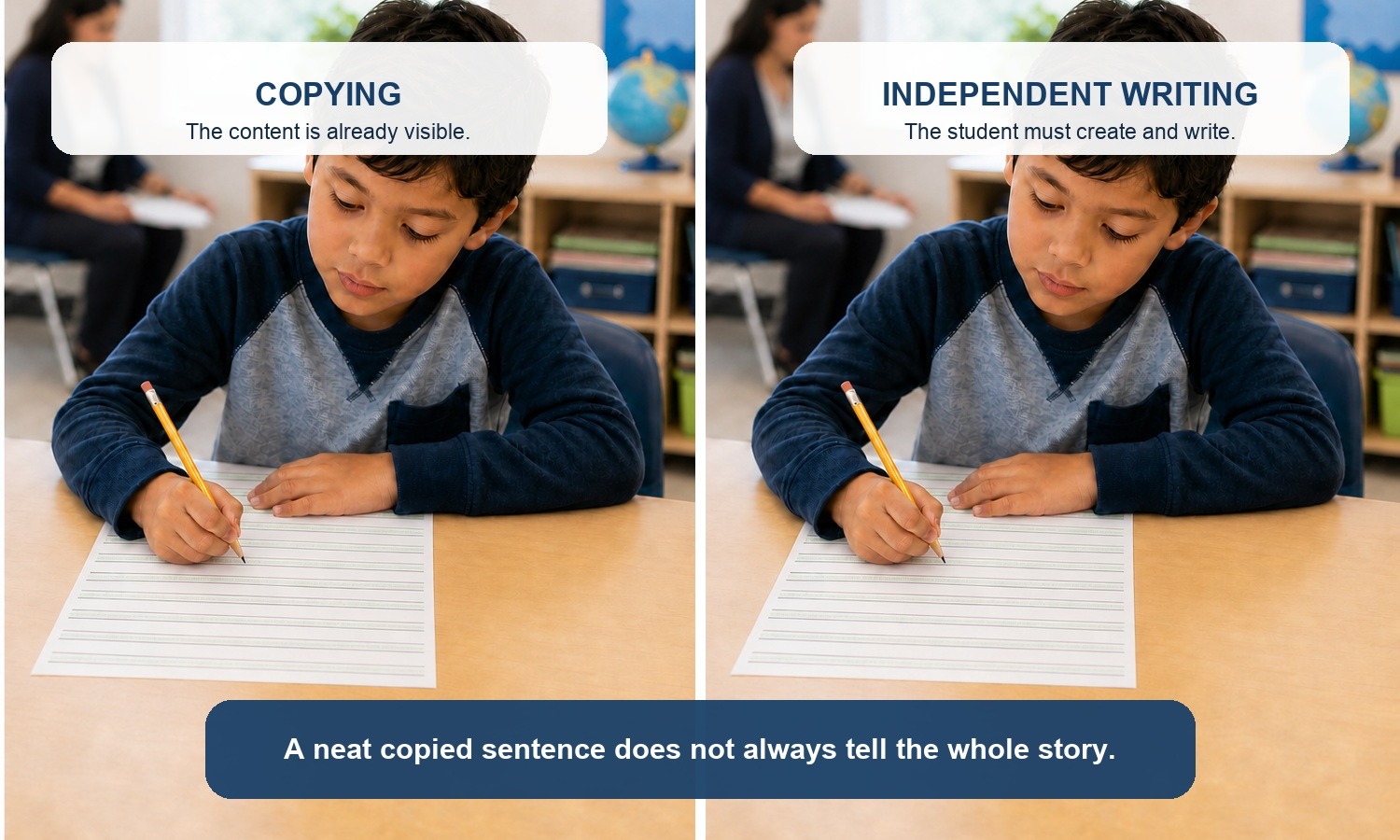
A neatly copied sentence does not necessarily mean that handwriting is fully functional during classroom work.
Copying reduces some demands because the student can see:
- The words
- The spelling
- The sentence structure
- The capitalization
- The punctuation
- The length and organization of the message
The content has already been generated.
Independent composition is different. During self-generated writing, the student must create the message and produce the handwriting at the same time.
Research supports examining handwriting across more than one type of task. Fogel et al. (2022) found significant differences in children’s handwriting legibility across best-copying, fast-copying, and free-writing tasks. Free writing was less legible than best-copying, and letter formation was the strongest predictor of overall legibility.
A functional handwriting assessment may therefore include:
- Copying from a nearby model
- Copying from the board
- Writing from dictation
- Answering a question
- Writing a paragraph
- Completing math work
- Taking notes
- Filling in a worksheet
- Writing within a limited space
- Writing under time expectations
The question is not only:
Can this student write legibly?
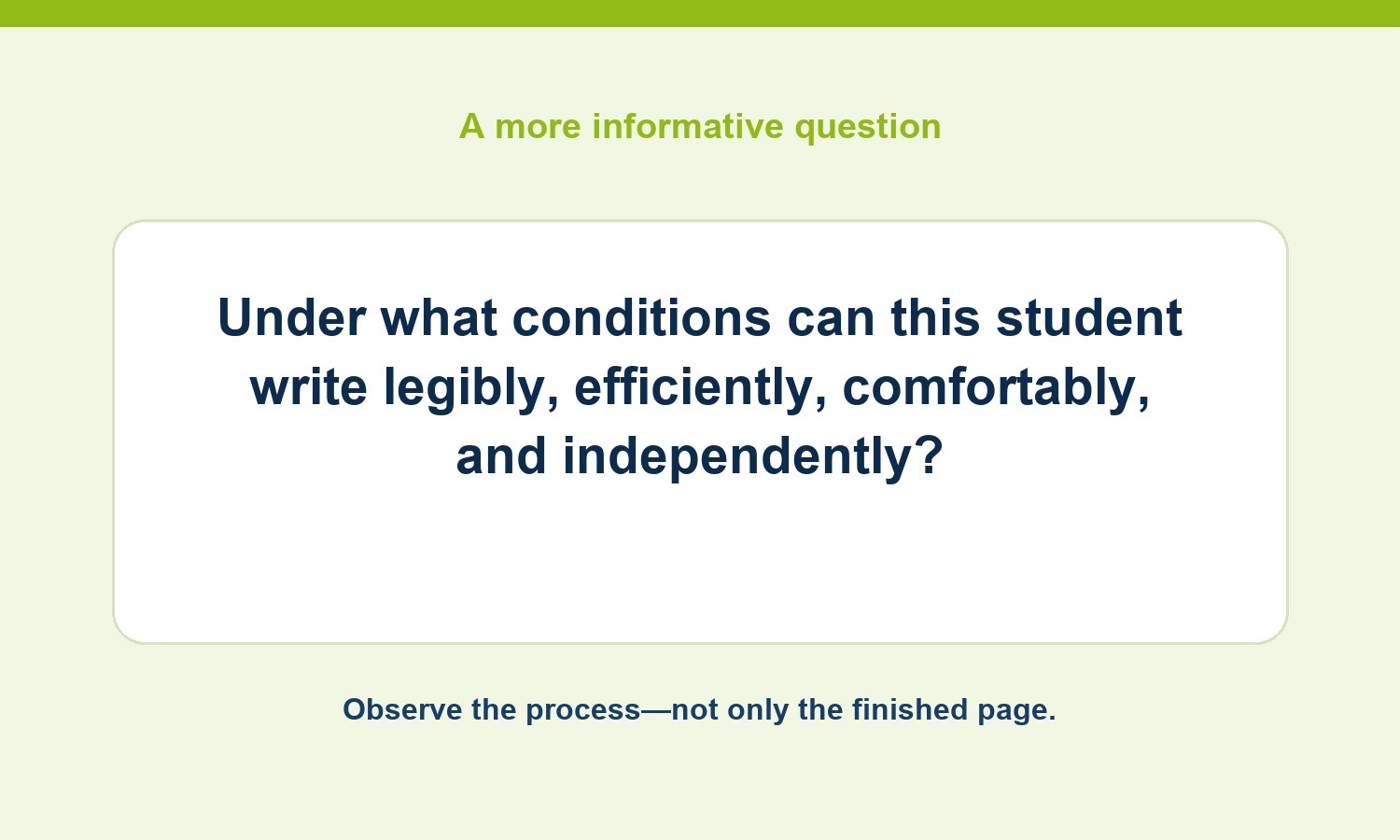
A more informative question is:
Under what conditions can this student write legibly, efficiently, comfortably, and independently?
Occupational therapy task analysis helps identify which part of the activity changes the student’s performance. The OT may vary the amount of writing, distance of the model, visual complexity, time demands, size of the writing space, level of idea generation, or available supports. Comparing performance across these conditions can help identify when the student’s handwriting begins to break down and which changes improve participation and independence.
How Executive Functions May Affect Written Performance
Executive functions do not explain every handwriting difficulty. However, they may help explain why performance changes when a writing task becomes more complex.
1. Working Memory Helps Hold the Message Together
Working memory allows a student to keep information available while using it.
While writing, a student may be trying to remember:
- The teacher’s directions
- The question being answered
- The idea for the sentence
- The next word
- The spelling of the word
- The correct letter sequence
- Where the word belongs on the page
- Whether a capital or punctuation mark is needed
If letter formation or spelling requires substantial conscious attention, the student may lose part of the message before finishing it.
Possible signs that the combined demands of a task may be overloading the student’s working-memory resources include:
- Omitting words or letters
- Repeating words
- Frequently asking for the directions again
- Beginning a sentence but not completing the idea
- Looking back at a model after nearly every letter
- Producing simpler written language than spoken language
- Forgetting spacing, capitalization, or punctuation while concentrating on content
- Losing track of where to write an answer
Working memory is an important contributor to written expression, but it is only one part of a larger writing system. An omitted word, missing capital, or incomplete sentence should not automatically be labeled a working-memory problem.
The same error could also relate to limited instruction, spelling difficulty, reduced attention, language formulation, rushing, fatigue, or difficulty monitoring written work.
2. Inhibitory Control Helps Manage Competing Responses
Inhibitory control helps students pause, resist distractions, and suppress responses that interfere with the immediate goal.
During writing, a student may need to resist:
- Looking at nearby classmates
- Responding to hallway sounds
- Drawing or doodling instead of writing
- Writing the first idea without considering the prompt
- Rushing ahead before completing a word
- Starting the next sentence before adding punctuation
- Erasing repeatedly in pursuit of perfection
- Leaving the task to obtain materials that are not needed
One student may begin immediately but make numerous omissions. Another may become distracted before writing the first word. A third may focus so intensely on correcting one letter that the overall assignment remains unfinished.
Telling a student to “pay attention” or “try harder” rarely identifies the action that needs to change.
A specific prompt is usually more useful:
- “Finish this word before looking back at the board.”
- “Add the period before starting the next sentence.”
- “Write this part, and then you may check your drawing.”
- “Write this sentence, and then stop at the visual marker.”
Specific cues make the expected behavior visible and manageable.
3. Cognitive Flexibility Supports Shifting Between Writing Demands
Writing requires repeated shifts.
A student moves between:
- Thinking and writing
- Listening and recording
- Looking at a model and looking back at the paper
- Remembering spelling and forming letters
- Generating ideas and checking conventions
- Writing continuously and pausing to revise
- Following one direction and then moving to the next
Some students become stuck on one part of the process. They may spend excessive time choosing a topic, correcting one letter, decorating a title, or rewriting the first sentence.
Others have difficulty returning to the task after an interruption or adjusting when the first strategy is not working.
These behaviors may sometimes look like procrastination, avoidance, or perfectionism. They may also reflect difficulty shifting attention, changing strategies, managing uncertainty, or disengaging from a preferred part of the task.
The behavior must be considered within the full context rather than assigned to executive functioning automatically.
4. Planning Affects Ideas and Page Organization
Planning is not limited to deciding what to say in a story. It can also affect how a student approaches the physical page.
The student may need to anticipate:
- Where to begin
- How much space is available
- Where to place the answer
- How to organize information
- Whether to skip a line
- When to start a new paragraph
- How to fit the response into the provided area
- Which materials are needed
- Which part of the assignment should be completed first
A student may understand the content but begin in the middle of the page, run out of room, crowd words together, skip sections, or place answers in the wrong location.
These errors may involve:
- Executive planning
- Visual-spatial organization
- Visual-motor integration
- Difficulty interpreting the worksheet
- Inattention
- Limited experience with the format
- Several factors occurring together
The appearance of the page alone cannot identify the underlying cause.
5. Self-Monitoring Supports Legibility and Accuracy
Self-monitoring allows a student to compare current performance with the intended goal.
During handwriting, the student may need to notice whether:
- letters are readable
- writing remains on the line
- word spacing is present
- the intended letters were written
- pencil pressure is becoming excessive
- the sentence is complete
- capitalization and punctuation are included
- another person will be able to read the work
A student may understand all of these expectations but fail to monitor them while composing.
For example, a student may say, “I know I need spaces,” immediately after producing a sentence without clear word boundaries.
This does not necessarily mean the student is careless. Knowing a rule and monitoring that rule while generating ideas, spelling words, forming letters, and remembering directions are different levels of performance.
Self-monitoring also depends on whether the student can accurately recognize the error. A child who does not yet discriminate between effective and ineffective spacing may require explicit instruction and visual examples rather than reminders to “check the work.”
6. Sustained Effort and Endurance Can Affect Performance
Written work often requires sustained mental and physical effort.
As an assignment continues, a student may:
- Write more slowly
- Pause more often
- Press harder on the pencil
- Change grasp patterns
- Slouch or lean on the desk
- Stop stabilizing the paper
- Produce larger or less controlled letters
- Leave out more information
- Rush through the final portion
- Seek opportunities to leave the task
- Refuse to review or edit the work
A decline over time is meaningful, but it does not point to one automatic explanation.
Reduced performance may relate to:
- Motor fatigue
- Hand pain
- Joint instability
- Reduced postural endurance
- Diminished attention
- Working-memory demands
- Emotional frustration
- Task difficulty
- Limited handwriting automaticity
- An interaction among several factors
Evaluating only the first sentence may miss the point at which performance begins to break down.
Adults should observe not only the completed page but also the amount of time, physical effort, prompting, frustration, and support required to produce it.
The Relationship Works in Both Directions
Executive-function demands may affect written performance, but inefficient transcription can also increase the demand on executive functions and working memory.
A student who must consciously think about letter formation has fewer cognitive resources available for planning and sentence construction.
A student who writes very slowly must hold ideas in mind for longer.
A student who experiences pain or fatigue must regulate discomfort while trying to continue the task.
A student who frequently stops to find letters, correct spelling, or remember directions may lose the flow of the message.
This may create a cycle:
- Handwriting or spelling requires excessive conscious effort.
- The student loses ideas, falls behind, or forgets directions.
- Errors and frustration increase.
- The student begins to rush, avoid, or disengage.
- The final product no longer represents what the student knows.
Research examining struggling writers supports considering transcription, oral language, executive functioning, working memory, and writing fluency together rather than treating writing as a single isolated skill (Ahmed et al., 2022).
This is why handwriting difficulties should not automatically be classified as motivation problems. Executive-function concerns should also not be used to dismiss genuine motor, visual-motor, sensory, language, or instructional needs.
What Recent Research Suggests
The following research comes from occupational therapy, education, psychology, and writing science. Together, these studies help explain why a student’s written performance may change as the motor, cognitive, language, and self-regulation demands of a task increase. For occupational therapists, the value of this research lies in understanding how transcription skills and task demands affect functional classroom participation.
A 2024 systematic review of 26 studies found that executive functions were associated with multiple aspects of children’s writing. Working memory was the most frequently studied and most consistently related component, while inhibition, cognitive flexibility, and planning were also associated with writing. The role of individual executive functions varied depending on the writing process being examined (Ruffini et al., 2024).
These findings support considering executive functioning as one part of a comprehensive writing assessment, but they do not establish executive dysfunction as the cause of a specific handwriting or composition problem.
Rocha et al. (2022) followed 222 Portuguese students from Grade 4 to Grade 5 and examined transcription skills, working memory, inhibition, cognitive flexibility, and text quality. Grade 4 spelling and cognitive flexibility predicted later text quality, but those longitudinal links were no longer significant after Grade 5 skills were considered. In the final model, concurrent transcription skills, cognitive flexibility, and inhibitory control predicted Grade 5 text quality.
The authors concluded that transcription and executive functions both contribute to writing, with relationships in this developmental period appearing more concurrent than longitudinal. For practice, this supports examining current transcription skills and executive demands together rather than treating them as competing explanations.
Research has also examined how children produce written language over time. Writing is often produced in bursts separated by pauses rather than as one perfectly continuous process. In 177 English-speaking Grade 2 students, Kim (2022) found that the amount of text produced between pauses was related to writing quality even after handwriting fluency, spelling, oral language, working memory, and attentional control were considered.
Pauses are not automatically a sign of difficulty. Students may pause to plan, select a word, spell, revise, or organize an idea. However, frequent pauses within words or very short bursts may suggest that handwriting, spelling, memory, attention, or idea generation is interrupting the writing process. For occupational therapists, observing when and why a student stops can provide useful information that is not visible in the final written product.
Valcan et al. (2024) studied 544 Australian Year 2 children completing handwritten and keyboarded compositions. The researchers examined executive functioning, handwriting and keyboarding automaticity, spelling, compositional fluency, and writing quality.
Structural equation modeling indicated that handwriting automaticity, keyboarding automaticity, and spelling mediated the relationship between executive functioning and compositional fluency and quality across both writing modes.
Because all skills were measured concurrently, the study identifies important relationships but does not prove that executive-function difficulties directly cause handwriting or composition problems.
Research focused specifically on legibility also shows that the nature of the task matters. Fogel et al. (2022) found significant differences in handwriting legibility across best-copying, fast-copying, and free-writing tasks in children ages 9 to 14. Letter formation was the strongest predictor of overall legibility, while free writing was less legible than best-copying.
Newer research further highlights the value of examining interactions rather than isolated skills. Dong et al. (2026) studied 244 Chinese primary school students, half identified with writing difficulties. Students with writing difficulties showed weaker performance on executive-function tasks and lower visual-motor integration scores than peers without writing difficulties. In structural models, working memory and inhibitory control were indirectly associated with spelling and sentence-writing performance through visual-motor integration, while cognitive flexibility did not show a significant pathway.
Because this study involved Chinese writing, the findings should not be generalized directly to alphabetic handwriting. However, the study provides current evidence that executive-function and visual-motor processes may interact in writing difficulties and supports considering both cognitive regulation and visual-motor performance during functional assessment.
Together, these studies reinforce an important point:
Written performance cannot always be understood by examining hand skills, executive functioning, language, or instruction in isolation.
A comprehensive assessment considers how transcription, cognition, motor performance, language, task demands, and the classroom environment interact.
For occupational therapy, these findings support evaluating more than the appearance of one handwriting sample. The OT can compare performance across copying, dictation, independent composition, note taking, worksheets, and keyboarding while observing speed, effort, pauses, pain, prompting, endurance, and independence. The purpose is not to diagnose executive functioning from handwriting, but to understand how the student performs as the demands of meaningful school activities change.
Why This Matters in Occupational Therapy
In school-based occupational therapy, the question is whether handwriting supports educational participation—not whether the page is perfect. Students use handwriting to record ideas, complete assignments, solve problems, take notes, and demonstrate knowledge. A difficulty may emerge only when the student must listen and write, copy from the board, generate an original response, work within limited space, meet a pace expectation, or sustain writing across time.
Activity analysis helps the OT identify which demands change performance and which supports improve access, efficiency, comfort, and independence.
The OT considers the interaction among:
- The student’s motor, visual-motor, sensory, cognitive, and self-regulation abilities
- The specific demands of the writing activity
- The physical and instructional environment
- The writing tools, paper, technology, and supports available
- The amount of assistance or prompting required
- The effect of the difficulty on participation, independence, and access to instruction
This functional perspective helps the team match supports to the barrier: direct skill instruction, environmental modification, compensatory strategy, assistive technology, accommodation, or a combination of approaches.
What Occupational Therapists Can Examine
When handwriting is inconsistent, an occupational therapist may examine how the student’s abilities, the writing task, and the classroom environment interact.
Areas to consider may include:
Physical and Motor Factors
Postural stability, joint stability, pencil grasp and pressure, fine motor coordination, bilateral coordination, paper stabilization, writing speed, pain, and fatigue.
Visual and Visual-Motor Factors
Visual-motor integration, visual-spatial organization, oculomotor demands, paper positioning, letter placement, alignment, and use of available writing space.
Transcription Factors
Letter-formation accuracy and automaticity, handwriting fluency, keyboarding fluency, the effect of spelling demands on written production, and the ability to maintain performance during longer tasks.
Although spelling is part of transcription, occupational therapists consider how it affects functional writing performance and collaborate with educators and other specialists when spelling assessment or instruction is needed.
Executive and Self-Regulation Factors
Task initiation, ability to remember directions, sustained attention, response to distractions, planning, organization, shifting between task components, self-monitoring, emotional response, and persistence.
Task and Environmental Factors
The amount and length of writing, copying demands, time expectations, worksheet design, writing-space size, classroom distractions, visual supports, adult prompting, accommodations, and alternative methods for producing written work.
The same observable behavior may have several possible explanations. Crowded writing may reflect reduced spatial planning, visual-motor difficulty, limited awareness of word boundaries, rushing, or difficulty fitting a response into the available space. Heavy pencil pressure may relate to motor control, joint stability, sensory feedback, fatigue, anxiety, or increased effort. Skilled occupational therapy assessment helps distinguish among these possibilities rather than assigning a cause based only on the appearance of the page.
The goal is not to attribute every handwriting problem to executive functioning.
The goal is to identify where the writing process is breaking down, under which conditions, and which supports improve functional participation.
Supports That Reduce Executive Load
Occupational therapy intervention should be based on the barrier affecting the student’s participation in the writing task. The OT may address underlying performance skills, modify the task or environment, teach compensatory strategies, introduce assistive technology, or combine these approaches.
Supports should be based on the student’s specific needs. A checklist will not correct an underlying letter-formation difficulty, and modified paper will not independently resolve difficulty generating or organizing ideas. Similarly, strengthening the hand will not address a writing breakdown caused primarily by working-memory demands or difficulty understanding the assignment.
Appropriate supports can reduce unnecessary demands and help students use their skills more independently during meaningful classroom activities.
Make Information Visible
Spoken directions are transient, while visual directions can remain available for the student to reference during the task.
Helpful supports may include:
- Written directions
- Models
- Alphabet references
- Word banks
- Checklists
- Visual paragraph structures
- Clearly marked writing areas
- Modified paper
- Examples of completed work
- Visual markers showing where to stop
- Numbered task steps
Directions should be brief enough for the student to use. A long checklist can create an additional burden rather than reducing one.
Separate Composing from Editing
Asking a student to generate ideas, spell accurately, form every letter correctly, maintain spacing, and edit punctuation at the same time may overwhelm the writing process.
A more manageable sequence may be:
- Plan or say the message.
- Record the message.
- Read what was written.
- Check one selected feature.
- Check a second feature when appropriate.
For example, the first review may focus only on whether every word is present. A second review may focus on capitals and punctuation.
The number of features checked should match the student’s developmental level and ability to use the strategy independently.
Use Specific Rather Than Global Prompts
“Write neatly” is broad and may not tell the student what to change.
More specific prompts include:
- “Keep these three letters in the shaded area.”
- “Leave a finger space after this word.”
- “Start this letter at the top.”
- “Finish the sentence and then check for a period.”
- “Read the last three words before you continue.”
- “Keep your helping hand on the paper.”
- “Write to this visual marker and then take a break.”
Specific prompts identify an observable action.
Build Predictable Routines
A consistent routine reduces the need to decide what to do at every step.
A writing routine might include:
- Read the direction.
- Position the paper.
- Place the helping hand.
- Say or plan the sentence.
- Write one section.
- Stop at the visual marker.
- Check one feature.
The routine should be practiced during instruction rather than introduced only when the student is already frustrated.
Reduce Memory Demands
Students who lose information while writing may benefit from:
- Repeating the direction in their own words
- Breaking directions into smaller steps
- Keeping the prompt visible
- Using a brief written plan
- Providing sentence starters
- Allowing the student to rehearse the sentence aloud
- Recording key words before writing
- Using graphic organizers
- Checking off completed steps
These supports reduce the amount of information that must be held mentally at one time.
Adjust the Task Without Eliminating Instruction
Possible accommodations include:
- Reduced copying
- Shorter writing segments
- Partially completed notes
- Modified paper
- Additional time
- Movement or hand breaks
- Keyboarding
- Speech-to-text
- A scribe for selected assignments
- Alternative ways to demonstrate knowledge
Accommodations should improve access while the student continues to receive appropriate instruction in areas of need.
For example, keyboarding may provide access for a longer classroom response while the student continues receiving handwriting instruction when handwriting remains an educational priority.
Teach Self-Monitoring Explicitly
Students may need direct instruction in how to recognize and correct specific errors.
A self-monitoring strategy might include:
- Comparing two spacing examples
- Highlighting spaces between words
- Circling one letter that is difficult to read
- Reading the sentence aloud
- Using a visual scale for pencil pressure
- Checking one line rather than an entire page
- Marking a personal goal before beginning
Self-monitoring should be concrete, limited, and connected to a skill the student understands.
Telling a student to check work is unlikely to help when the student does not know what to look for or how to correct it.
Look at the Process, Not Just the Page
The final paper does not reveal:
- How much effort the student used
- How long the task took
- How often the student lost an idea
- How many prompts were required
- Whether directions had to be repeated
- Whether the student experienced pain
- Whether performance declined over time
- Whether the student understood the content
- Whether the work was completed independently
A student may produce acceptable handwriting but require twice as long as classmates.
Another may write neatly for one sentence but be unable to sustain that quality.
A third may demonstrate strong handwriting while copying but struggle when independently generating a response.
A fourth may have legible handwriting but produce very little because transcription remains slow and effortful.
Understanding the relationship between executive functioning, transcription, and handwriting helps adults move beyond comments such as:
- “He knows how to do it.”
- “She just needs to slow down.”
- “He could write neatly if he tried.”
- “She is being careless.”
- “He is avoiding the work.”
Instead, educators and therapists can ask:
- Which demands are competing for this student’s attention?
- Is letter formation sufficiently automatic?
- What information is the student trying to hold in mind?
- Does the student understand the writing expectation?
- At what point does performance decline?
- Is pain or fatigue present?
- How much prompting is required?
- Which support improves independence?
- Does the student recognize the errors?
- Is the writing task accurately measuring knowledge?
Handwriting is not merely a motor product on a page. It is a tool students use to participate in educational occupations—to record ideas, solve problems, communicate, and demonstrate learning.
Executive functions help coordinate this work, but they are one part of a larger system that also includes transcription, language, motor and visual-motor performance, instruction, physical comfort, task demands, and the environment.
When we identify where the writing process breaks down—and under which conditions it improves—we can move beyond assumptions about effort or carelessness and choose supports that help the student write more independently, efficiently, and successfully in the classroom.
References
Ahmed, Y., Kent, S., Cirino, P. T., & Keller-Margulis, M. (2022). The not-so-simple view of writing in struggling readers/writers. Reading & Writing Quarterly, 38(3), 272–296. https://doi.org/10.1080/10573569.2021.1948374
Berninger, V. W., & Winn, W. D. (2006). Implications of advancements in brain research and technology for writing development, writing instruction, and educational evolution. In C. A. MacArthur, S. Graham, & J. Fitzgerald (Eds.), Handbook of writing research (pp. 96–114). Guilford Press.
Diamond, A. (2013). Executive functions. Annual Review of Psychology, 64, 135–168. https://doi.org/10.1146/annurev-psych-113011-143750
Dong, R., Yin, L., Zheng, K., & Chen, K. (2026). Executive function and writing performance among primary school students with writing difficulties: The mediating role of visual-motor integration. Journal of Learning Disabilities. Advance online publication. https://doi.org/10.1177/00222194261417608
Fogel, Y., Rosenblum, S., & Barnett, A. L. (2022). Handwriting legibility across different writing tasks in school-aged children. Hong Kong Journal of Occupational Therapy, 35(1), 44–51. https://doi.org/10.1177/15691861221075709
Kim, Y.-S. G. (2022). Do written language bursts mediate the relations of language, cognitive, and transcription skills to writing quality? Written Communication, 39(2), 200–227. https://doi.org/10.1177/07410883211068753
Rocha, R. S., Castro, S. L., & Limpo, T. (2022). The role of transcription and executive functions in writing: A longitudinal study in the transition from primary to intermediate grades. Reading and Writing, 35(8), 1911–1932. https://doi.org/10.1007/s11145-022-10256-8
Ruffini, C., Osmani, F., Martini, C., Giera, W.-K., & Pecini, C. (2024). The relationship between executive functions and writing in children: A systematic review. Child Neuropsychology, 30(1), 105–163. https://doi.org/10.1080/09297049.2023.2170998
Valcan, D. S., Malpique, A., Pino-Pasternak, D., Asil, M., & Teo, T. (2024). The contributions of executive functioning to handwritten and keyboarded compositions in Year 2 children. Contemporary Educational Psychology, 77, Article 102272. https://doi.org/10.1016/j.cedpsych.2024.102272