


Primitive Reflexes in Preschool Classrooms: Structured Supports for Students with Learning and Regulation Needs
By Irene Hannam, MS OTR/L
Why Talk About Primitive Reflexes in Special Education?
Primitive reflexes are the automatic movements babies are born with—like grasping, rooting, or rolling. These reflexes should fade by around one year of age as the brain matures.
But for children with developmental delays, autism, or other learning differences, these reflexes may stick around longer than expected. When that happens, they can make it harder for students to:
- Sit still during circle time
- Hold crayons or scissors comfortably
- Stay calm and regulated in busy classrooms
- Transition smoothly between activities
- Participate fully in play and early academics
Why They Matter in Special Education Preschool:
- Students may wiggle constantly in circle or tip their chairs.
- Hand grasp may stay tight or awkward, making coloring difficult.
- They may avoid playground equipment or ball games.
- Attention spans can be short, with frequent meltdowns.
- Reflexes keep the body in a “fight or flight” state, making calming very hard.
Signs to Watch For:
- Very fidgety, sliding in seat
- Still fist-grasping crayons
- Avoids tummy time or crawling play
- Startles easily, cries at sudden noise
- Difficulty calming after transitions
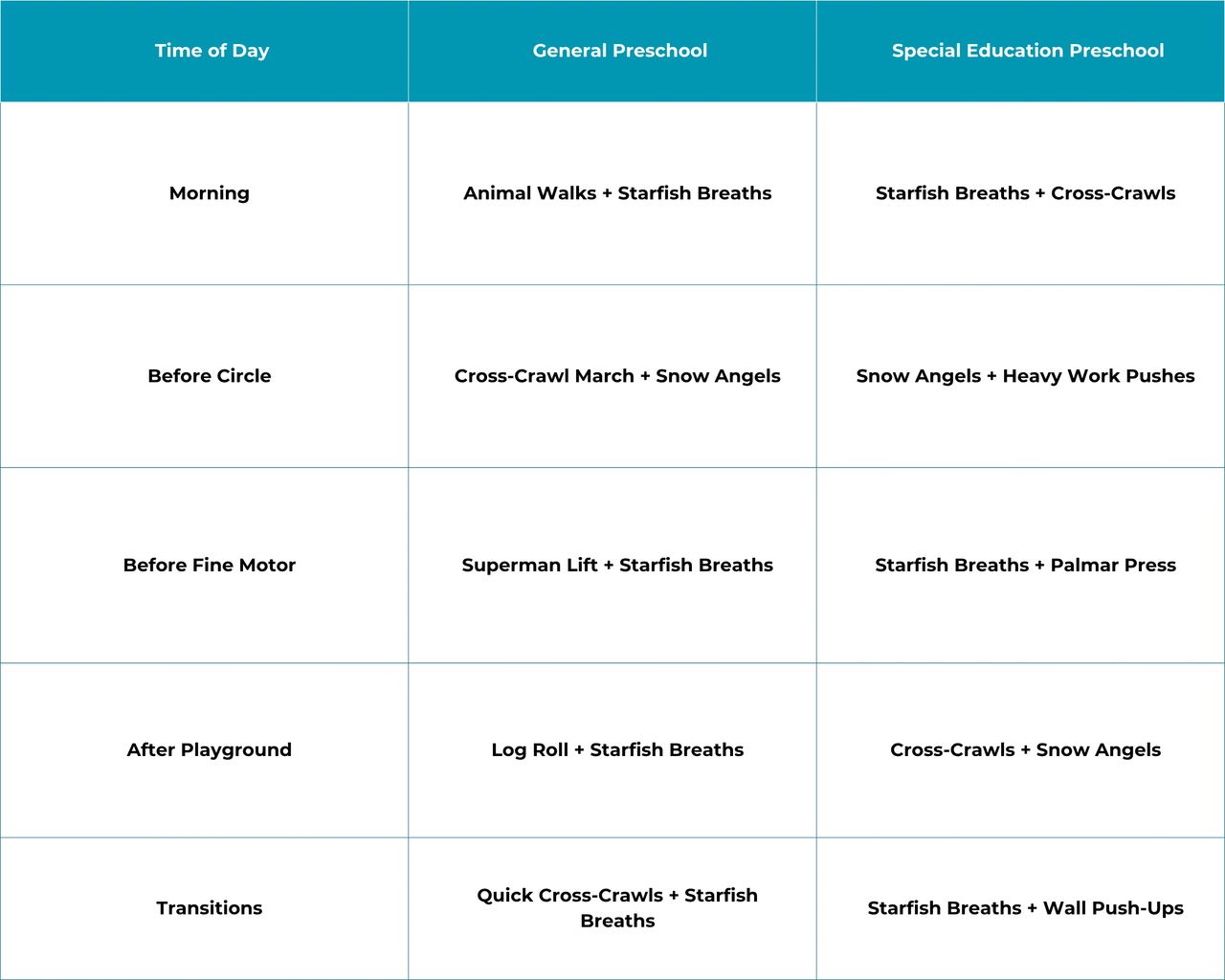
When to Use Movement Breaks:
Structured breaks work best when they’re short and routine. Ideal times include:
- Arrival routine – regulate before class begins
- Before circle/story time – help bodies still and calm
- Before structured work (centers, therapies) – support posture and focus
- After playground/sensory play – reset for learning
- During transitions – prevent overload
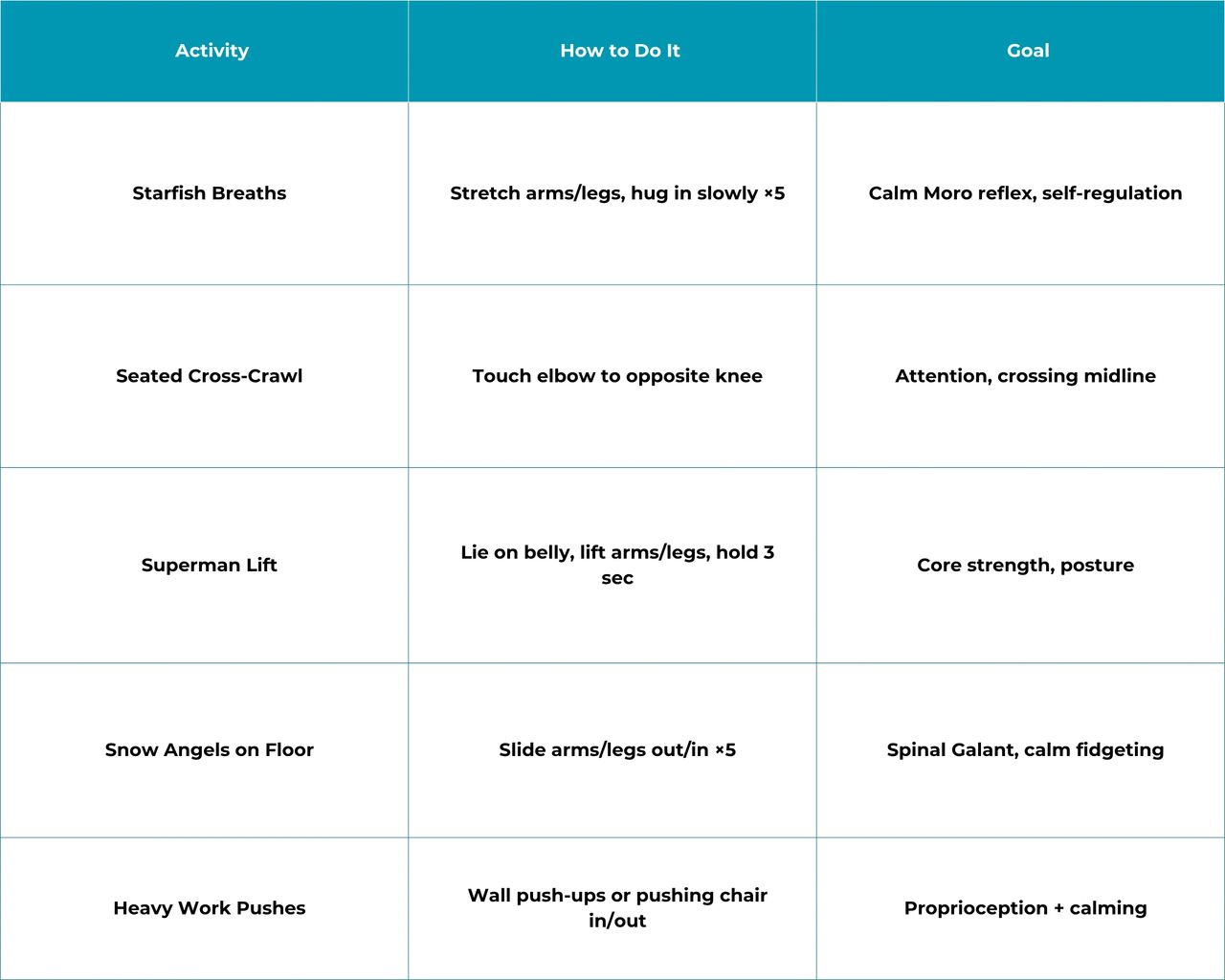
Structured Movement Menu (1–2 per break, 1–2 minutes each)*
Teacher Takeaway:
In special education preschool, reflex breaks should be:
- Short (1–2 minutes)
- Structured (same routine each day)
- Calming (proprioceptive and regulating activities)
This approach helps students regulate emotions, sit more easily at circle, and participate more fully in early learning tasks.
Summary:
- General Preschool → playful, group-based breaks woven into circle and centers.
- Special Education Preschool → structured, shorter breaks with extra calming/proprioceptive input.
- Both approaches set the foundation for posture, attention, and early learning readiness.
* Modifications for Special Education Preschool Reflex Activities
Starfish Breaths
- Modification: Instead of full stretch + hug, students can just open/close arms while seated or hug a stuffed animal for feedback.
- Why: Provides calming proprioception and makes the movement more concrete.
Seated Cross-Crawl
- Modification: If crossing midline is too hard, have them tap knees with both hands or march feet in place first, then add elbow-to-knee with hand-over-hand help.
- Why: Breaks the skill down and avoids frustration.
Superman Lift
- Modification: Hold for 1–2 seconds only, or rest with a small pillow/towel under chest for support.
- Why: Student may fatigue quickly or have low trunk strength.
Snow Angels on Floor
- Modification: Do small movements with just arms or just legs or perform standing against a wall if floor work is challenging.
- Why: Supports kids with low endurance, sensory defensiveness, or difficulty lying flat.
Heavy Work Pushes
- Modification: Instead of weighted bins, let students push a chair or do wall push-ups with visual targets (hands on stickers).
- Why: Keeps it accessible for all motor levels and still provides deep proprioceptive input.
Additional Teacher Tips
- Keep stations short (10–15 seconds) and let students repeat only if engaged.
- Use visuals (icons, pictures of animals, arrows on the floor) to guide the sequence.
- Offer choice (“Do you want to be a bear or a frog?”) to build buy-in.
- Allow sensory tools (weighted lap pad, fidget) right after movement to help transition back to seated work.
References:
- Feldhacker, D. R., et al. (2021). Primitive reflexes and scholastic performance. JOT Schools & Early Intervention, 14(4), 416–431.
- Gieysztor, E. Z., et al. (2018). Persistence of primitive reflexes in preschool children. Archives of Medical Science, 14(1), 167–173.
- Melillo, R., et al. (2020). Primitive reflex reduction and academic performance in ADHD. Frontiers in Public Health, 8, 431835.
- Richards, L., et al. (2022). Retained reflexes and handwriting difficulty. AJOT, 76(Suppl. 1).
Disclaimer
I am an occupational therapist providing information intended to support academic success in students. This resource is designed for teachers, parents, and occupational therapy professionals as a general guide. It is not medical advice, diagnosis, or treatment, and should not be used as a substitute for individualized medical care. Please consult appropriate professionals for individual medical or therapeutic concerns.

