

Description
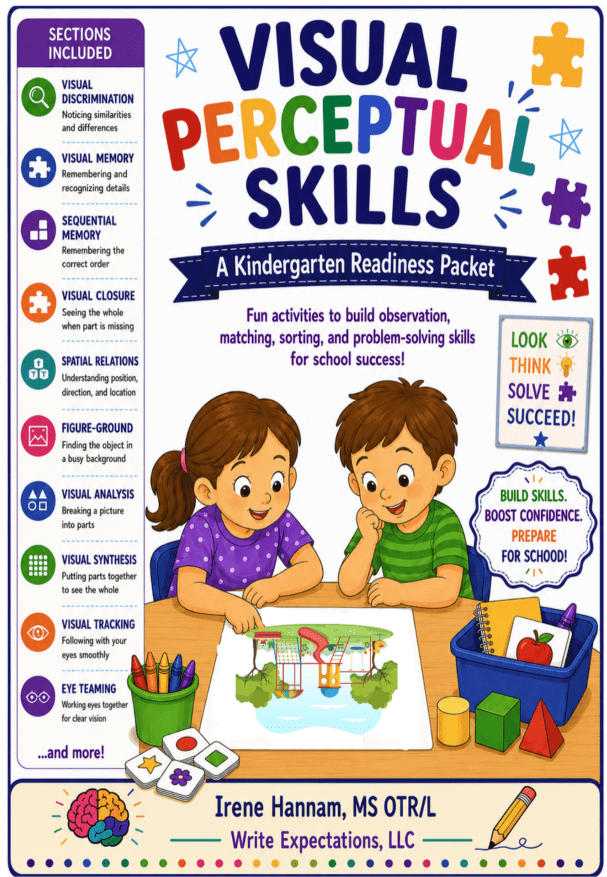
Visual-perceptual skills help children make sense of what they see. These skills allow children to notice details, find objects in a busy space, remember visual information, understand where objects are located, recognize shapes and pictures when they look different, and see how parts fit together to make a whole.
These skills are important for kindergarten because children use visual perception throughout the school day. They use it when they find their cubby, locate materials in a backpack, match pictures, sort objects, follow classroom directions, complete puzzles, recognize patterns, find items on a worksheet, and begin to understand early print and classroom symbols. This packet provides playful, kindergarten-readiness activities that help children practice visual-perceptual skills
in a developmentally appropriate way.
What Makes This Packet Different from Packet 1?
This packet is designed to focus on visual perception, not handwriting, drawing, or cutting skill.
Many young children are still developing pencil control, scissor skills, hand strength, and visual-motor coordination. If every task requires drawing, writing, or cutting, it can be difficult to know whether the child is struggling with visual perception or with the motor demands of the task. For that reason, this packet uses motor-reduced response options whenever possible.
Children may respond by:
– Pointing
– Circling
– Marking a target
– Placing a sticker
– Placing a small object or token
– Selecting from choices
– Verbally identifying an answer
Some pages include optional cutting or gluing activities. When cutting is included, an adult may cut the pieces ahead of time so the child can focus on the visual-thinking part of the task.
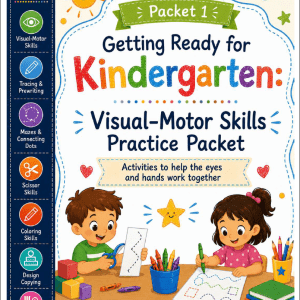
This packet pairs well with Packet 1: Kindergarten Visual-Motor Skills Practice Packet, which focuses more on prewriting, tracing, mazes, coloring, cutting, and drawing skills.
How to Use This Packet
This packet can be used by parents, caregivers, preschool teachers, pre-K teachers, occupational therapists, and other early childhood professionals.
You do not need to complete the packet all at once. In fact, it is better to use a few pages at a time.
A good starting point is: 1 – 2 pages per day or 5 – 10 minutes at a time
Young children often do best with short, successful practice sessions.