



Primitive Reflex Integration: Bridging the Gap Between OT and Academic Achievement
By Irene Hannam, MS OTR/L
Why Primitive Reflexes Matter in School Participation:
Despite rigorous handwriting drills and sensory diets, some students continue to struggle. Emerging literature pinpoints a hidden contributor: retained primitive reflexes that disrupt postural control, oculomotor stability, and executive functions essential for classroom participation (Feldhacker et al., 2021; Melillo et al., 2020). School-based OTs are uniquely positioned to identify these reflexes and embed efficient, evidence-based integration strategies across service tiers.
Primitive Reflexes & School Participation:
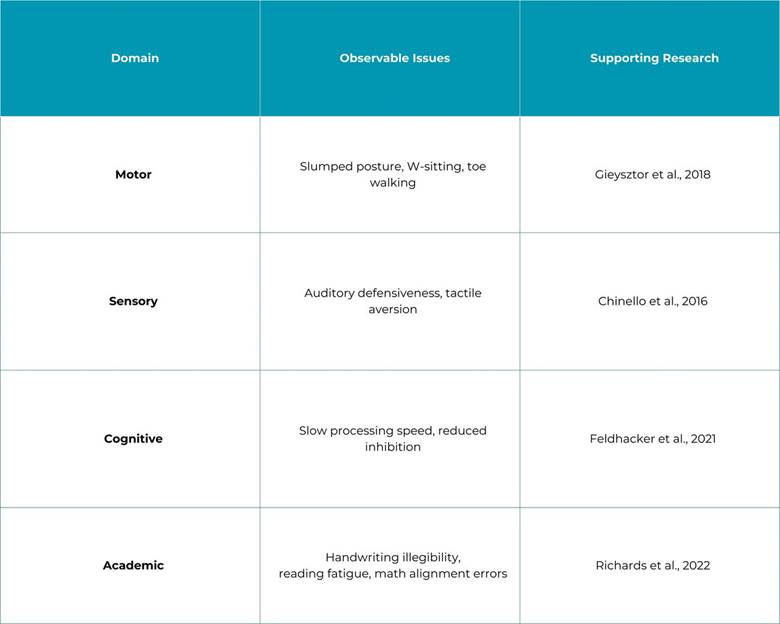
· Handwriting: Active ATNR correlates with poor spacing, reversals, and shoulder instability; Spinal Galant drives constant chair-wiggling that lowers pencil control and endurance (Richards et al., 2022).
· Reading: STNR compromises near-far visual shifts—critical for copying notes from the board and sustaining reading fluency (Sharma & Saxena, 2023).
· Cognitive Processing: Persistent primitive reflexes can interfere with the development of motor planning and cognitive flexibility, potentially leading to academic underperformance and executive dysfunction (Martello, 2023; Grzywniak, 2017).
· Behavior: An unintegrated Moro reflex keeps the sympathetic nervous system in a heightened state of arousal, magnifying startle responses, impulsivity, and emotional lability, while diminishing working memory and self-regulation skills (Martello, 2023).
· Motor Skills: Retained primitive reflexes disrupt gross and fine motor maturation, limiting participation in recess, PE, and classroom fine-motor tasks (Gieysztor et al., 2018; Chinello et al., 2016).
Neuro-Functional Impact Snapshot:
Why OTs Should Screen for Retained Reflexes:
· Evaluation: Incorporate a quick primitive reflex screening during initial evaluations for students presenting with handwriting delays, postural instability, attention difficulties, or sensory challenges.
· Root-Cause Clarity: Reflex screening uncovers hidden neuromotor immaturities that explain persistent fine motor, visual tracking, or sensory modulation challenges that may otherwise remain misattributed.
· Quick Tools: A simple 5-item clinical screen—targeting ATNR, STNR, TLR, Moro, and Spinal Galant—can be completed in less than 10 minutes (Konicarova & Bob, 2013).
· Progress Monitoring: Reflex scores provide objective, quantifiable data that can be re-assessed over time to document intervention efficacy. Decreased reflex retention often parallels gains in posture, endurance, attention, and motor skill proficiency (Feldhacker et al., 2021; Overvelde, 2023).
Aligning Reflex Integration with MTSS:
School-wide reflex integration programs have been shown to reduce off-task behavior by 21% and improve handwriting legibility after eight weeks in a K–2 cohort (Sharma & Saxena, 2023). These reflex-rich movement breaks qualify as universal supports under the Multi-Tiered System of Supports (MTSS) framework.
Understanding MTSS:
MTSS (Multi-Tiered System of Supports) is a school-wide framework designed to promote academic achievement and positive behavior for all students through layered supports:
- Tier 1 = Universal strategies used with every student, every day.
- Tier 2 = Targeted interventions for students needing additional support.
- Tier 3 = Intensive, individualized interventions.
The stronger Tier 1 supports are the fewer students need Tier 2 or Tier 3 interventions. MTSS emphasizes early identification, prevention, and equitable access to services.
How Reflex-Integration Fits Tier 1:
Primitive reflex movement breaks are short, structured, developmentally supportive activities that can be delivered to the entire class—just like traditional brain breaks.
Because they are:
- Universal (every student participates)
- Preventive (strengthening motor foundations before problems emerge)
- Time-efficient (under 5 minutes)
- Data-supported (evidence of academic and behavioral gains), they fully meet the criteria for a Tier 1 support within MTSS frameworks (MTSS Center, 2024; MTSS Center, 2025).
Practical Impact: School-Wide Benefits:
- Reflex activities improve classroom regulation, handwriting, and attention without requiring extra staffing or costly materials.
- Embedding these movements into daily routines (e.g., after recess, before writing tasks) strengthens the entire Tier 1 foundation, helping more students stay successful in general education settings.
A Few Evidence-Based Integration Techniques within OT Sessions:
1. Developmental Sequence Circuits: Rolling ➞ belly crawl ➞ bear walk ➞ hopping to retrace early neurodevelopmental milestones.
2. Isometric Holds: Superman holds and plank variations to inhibit TLR and Moro reflexes.
3. Rhythmic Movements: Slow rocking, prone extension, and metronome-guided activities to stimulate midbrain maturation (Melillo et al., 2020).
4. Midline Crossing Exercises: Cross-crawl marches, lazy 8 tracing, and bilateral coordination games to reinforce brain hemispheric integration.
Pair reflex integration with task-specific practice (e.g., fine motor centers, handwriting drills) to maximize cortical carryover into academic skills.
Embedding Reflex Work into the Daily School Routine:
Movement-based interventions should become a normalized, integrated part of the school day to reinforce reflex inhibition. A few include:
· Animal Walks: Use bear walks, crab walks, and frog jumps during transitions.
· Cross-Crawl Brain Breaks: Seated or standing cross-crawl sequences every 45 minutes (1–2 minutes).
· Morning “Ready-Body” Circuit: Quick start routines including Starfish Breaths, planks, and pencil warm-up tasks (total 6–8 minutes).
· Incorporate into PE Classes: Design warm-up activities that include developmental movements to maximize exposure across service tiers.
Boost Learning with Brain-Based Movement:
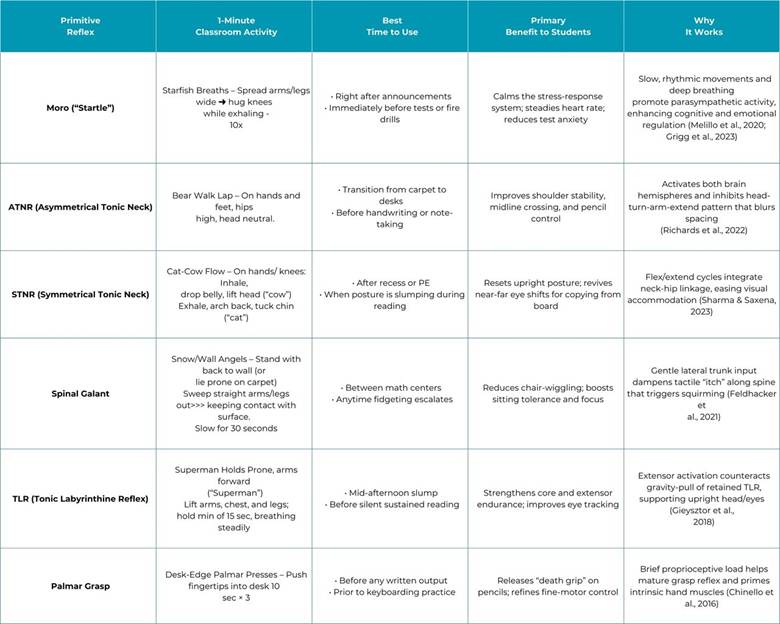
A Targeted Movement Break Planner matches simple activities to the best times of the school day, helping students calm, focus, and build the strong neurological foundations needed for academic success.
Collaboration Blueprint for Reflex Integration Success:
Teachers:
- Partner with OTs to integrate reflex-based movements into the classroom routine (e.g., Starfish Breaths, Cross-Crawls, Wall Push-ups).
- Provide laminated visual cue cards at student desks or centers for quick independent practice.
- Model exercises during transition times or brain breaks to reinforce consistency and normalize movement as part of classroom culture.
- Track simple participation checklists for movement breaks to support RTI/MTSS documentation.
Parents:
- Send brief video links demonstrating home exercises tailored to their child’s needs, ensuring accessibility for busy families.
- Offer a simple 5-minute daily routine plan (e.g., morning stretch + evening crawl or cross-crawl).
- Provide a progress chart (e.g., sticker chart or calendar) to build student ownership and parent involvement.
- Emphasize how short, playful activities at home enhance learning, emotional regulation, and even smoother morning routines.
Administrators:
- Present baseline and progress monitoring data showing improvements in reflex scores correlated with gains in handwriting, reading fluency, attention, and behavior regulation.
- Emphasize the cost-effectiveness of early reflex screening and intervention compared to future special education referrals, 504 accommodations, or behavioral interventions.
- Advocate for routine reflex screenings in early elementary grades (K–2), aligned with MTSS universal screening practices.
- Highlight that addressing neuromotor immaturity early reduces later academic skill gaps and behavioral incidents, supporting stronger long-term educational outcomes.
Quick Tip: Building daily movement habits across home, school, and administrative levels maximizes reflex integration success, supporting stronger academic, behavioral, and functional outcomes!
Sample Classroom Integration Guide (for Teachers & OTs):
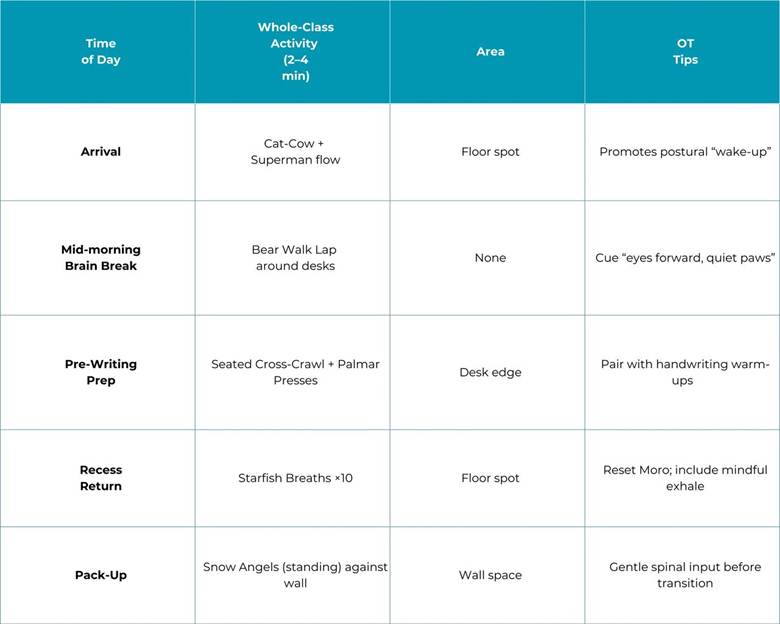
Movement Break Definitions: Classroom-Friendly Guide
Cat-Cow + Superman Flow
· Cat-Cow: On hands and knees, inhale to arch your back (cow), exhale to round your back (cat).
· Superman Flow: Transition onto your belly, lift arms, chest, and legs. Hold 3–5 seconds. Return to Cat-Cow. Repeat 5 times.
Purpose: Improves spinal flexibility, strengthens core, supports Tonic Labyrinthine Reflex (TLR) integration.
Bear Walk Lap Around Desks
· Movement: Hands and feet on floor, hips high. Walk like a bear around the room.
Purpose: Builds shoulder and core stability, enhances coordination, supports Symmetrical Tonic Neck Reflex (STNR) integration.
Seated Cross-Crawl + Palmar Presses
· Seated Cross-Crawl: Sit, touch right elbow to left knee, then left elbow to right knee. Alternate 30 seconds.
· Palmar Presses: Press palms together in front of chest firmly for 10 seconds, release. Repeat.
Purpose: Improves midline crossing, bilateral integration, strengthens postural muscles; supports ATNR and palmar grasp reflex integration.
Starfish Breaths ×10
· Movement: Inhale to stretch arms and legs into a star shape. Exhale to hug arms and legs inward. Repeat slowly 10 times.
Purpose: Calms the nervous system, integrates the Moro reflex, improves self-regulation and emotional control.
Snow Angels (Standing) Against Wall
· Movement: Stand against a wall, slide arms up and down like making snow angels. Keep arms and back touching the wall. (Note: This exercise may also be completed supine on a mat or carpet area.)
Purpose: Strengthens postural muscles, improves shoulder stability, supports gross motor coordination needed for classroom tasks. The Snow Angel exercise helps integrate the Spinal Galant reflex by promoting coordinated movements and sensory processing.
Quick Tip: Practice these activities for 1–2 minutes during transitions, before tests, or after recess to support learning, regulation, and brain readiness!
Implementation Hints:
- Schedule into lesson plans—consistency outperforms intensity.
- Use student leaders or class jobs to demo moves.
- Track anecdotal gains (time-on-task, handwriting samples) to reinforce fidelity.
Conclusion: Advancing Neuromotor Readiness
When occupational therapists incorporate reflex integration into school-based practice, they address a foundational layer of the occupation of “student.” The payoff is significant: steadier posture, clearer handwriting, calmer state regulation, improved visual tracking, stronger bilateral coordination, and—critically—greater access to and engagement in academic tasks. Embedding reflex-based interventions empowers students with the physical readiness they need to fully participate, achieve, and thrive in their learning environments.
Targeted Movement Break Planner:
Matching Primitive Reflex Activities to Optimal Times of the School Day
Prepared by: Irene Hannam, MS OTR/L
Scheduling Tips:
- Anchor three reflex-rich breaks (≤ 5 min total) at the same points daily—e.g., 9 a.m., 11 a.m., 1 p.m.—so they become routine, not add-ons.
- Layer with academics: Pair ATNR or Palmar drills right before handwriting; use Moro or STNR sets before high-stakes tasks requiring calm focus or upright posture.
- Data check: Have teachers tally off-task behavior or handwriting errors for one-week pre/post implementation; share results.
References:
· Chinello, A., Di Brina, C., Carboncini, M. C., & Ricciardi, E. (2016). Motor behaviors and primitive reflexes in children with autism spectrum disorders. Autism Research, 9(1), 69–77. https://pmc.ncbi.nlm.nih.gov/articles/PMC9301367/
· Feldhacker, D. R., Cosgrove, R., Feiten, B., Kreifels, A., & Schindler, M. (2021). The correlation between retained primitive reflexes and scholastic performance among early elementary students. Journal of Occupational Therapy, Schools, & Early Intervention, 14(4), 416–431. https://doi.org/10.1080/19411243.2021.1959482
· Gieysztor, E. Z., Kawczynski, A., Michalczuk, A., Choińska, A. M., & Paprocka-Borowicz, M. (2018). The persistence of primitive reflexes and associated motor problems in healthy preschool children. Archives of Medical Science, 14(1), 167–173. https://pubmed.ncbi.nlm.nih.gov/29379547/
· Grigg, T. M., Culpan, I., & Fox-Turnbull, W. (2023). Primitive reflex integration and reading achievement in the classroom. Journal of Neurology and Experimental Neuroscience, 9(1), 18–26. https://doi.org/10.17756/jnen.2023-103
· Grzywniak, C. (2017). Integration exercise programme for children with learning difficulties who have preserved vestigial primitive reflexes. Acta Neuropsychologica, 15(3), 241–256. https://doi.org/10.5604/01.3001.0010.5491
· Konicarova, J., & Bob, P. (2013). Retained ATNR and ADHD symptoms in school-aged children. Neuropsychiatric Disease and Treatment, 9, 1457–1461. https://doi.org/10.2147/NDT.S51252
· Martello, J. M. (2023). Persistent primitive reflex and developmental delay in the school-aged child. The Journal for Nurse Practitioners, 19(10), 104767.
· Mehta, P., Vyas, N., & Ashish. (2024). The effect of retained primitive reflexes on academic success in middle school children: A pilot study. Journal of Current Research and Review. Advance online publication.
· Melillo, R., Leisman, G., Mualem, R., Ornai, A., & Carmeli, E. (2020). Persistent childhood primitive reflex reduction effects on cognitive, sensorimotor, and academic performance in ADHD. Frontiers in Public Health, 8, 431835. https://doi.org/10.3389/fpubh.2020.431835
· Richards, L., Avery, R., Gray, S., & Price, R. (2022). Retained reflexes and handwriting difficulty. The American Journal of Occupational Therapy, 76(Suppl. 1), 7610505010p1. https://doi.org/10.5014/ajot.2022.76S1-RP10
· Sharma, Y., & Saxena, A. (2023). Problems associated with persisting primitive reflex in healthy school-going children. Journal of Clinical and Diagnostic Research, 17(12), SC05–SC08. https://doi.org/10.7860/JCDR/2024/75507.20016

